Graphene Defies Fundamental Law of Physics, Exhibits Liquid-Like
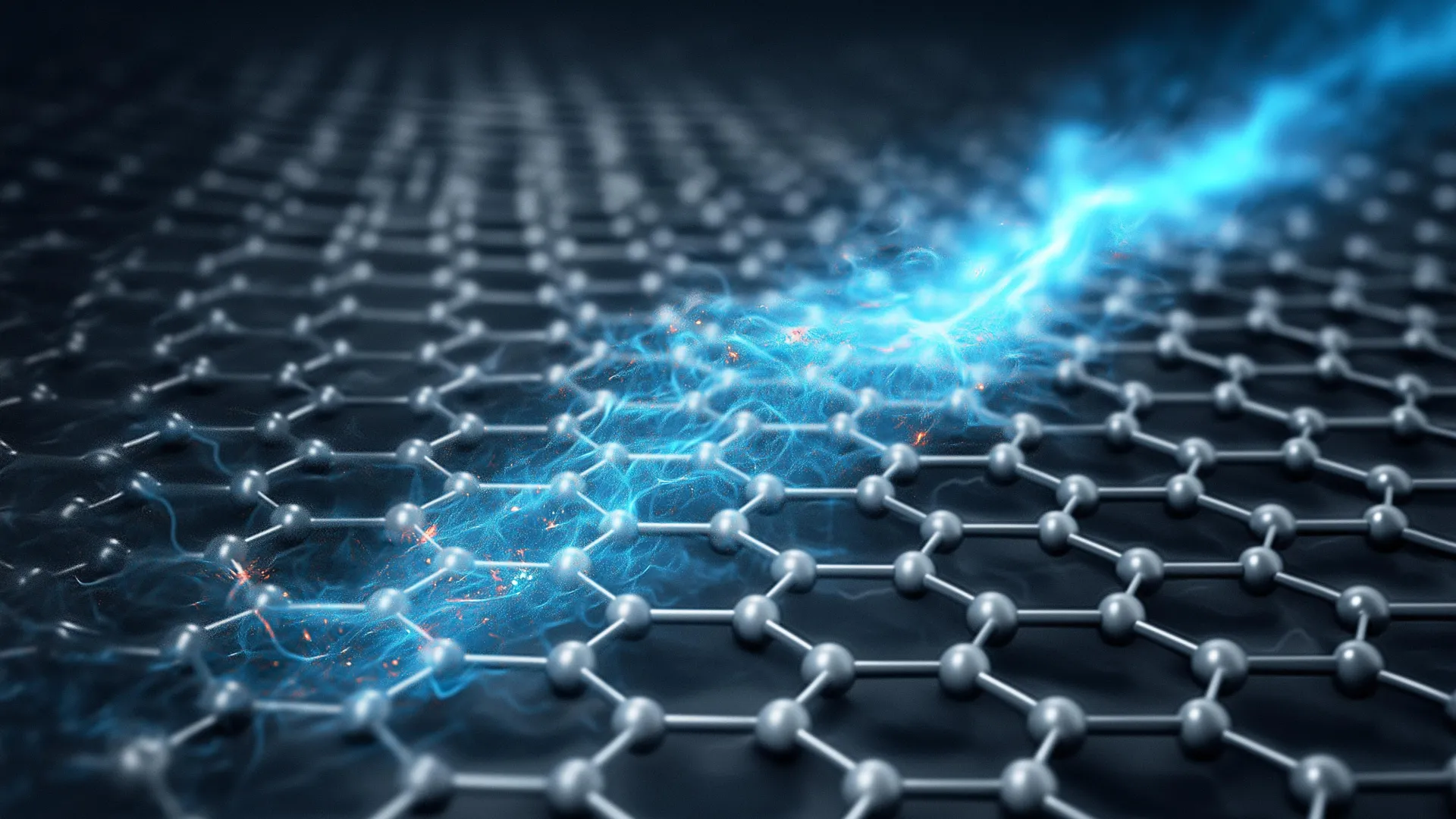
Researchers at the Indian Institute of Science (IISc) have made a groundbreaking observation of electrons in **graphene** flowing like a nearly frictionless liq
Summary
Researchers at the Indian Institute of Science (IISc) have made a groundbreaking observation of electrons in **graphene** flowing like a nearly frictionless liquid, contradicting the **Wiedemann-Franz law**. This phenomenon, known as a **Dirac fluid**, occurs at the **Dirac point**, where graphene exhibits a unique state of matter. The discovery, published in **Nature Physics**, has significant implications for **quantum technology** and **materials science**. [[graphene|Graphene]] has been a subject of intense research since its discovery in 2004, and this finding highlights its potential for **quantum computing** and **sensing applications**. The research was conducted in collaboration with the **National Institute for Materials Science** in Japan, demonstrating the global nature of scientific inquiry. [[quantum-computing|Quantum Computing]] and [[materials-science|Materials Science]] are expected to benefit from this breakthrough.
Key Takeaways
- Researchers have observed a Dirac fluid state in graphene, contradicting the Wiedemann-Franz law
- The Dirac fluid state occurs at the Dirac point, where graphene exhibits a unique state of matter
- The discovery has significant implications for quantum technology and materials science
- The potential for graphene to enable the development of highly sensitive quantum sensors and quantum computing applications makes this discovery a game-changer for sensing and measurement technologies
- The discovery highlights the importance of collaboration and interdisciplinary approaches in advancing scientific knowledge
Balanced Perspective
The discovery of a **Dirac fluid** state in **graphene** is a significant scientific finding, but its practical implications are still being explored. While the observation of a **Dirac fluid** state is a major breakthrough, it is essential to understand the underlying physics and the conditions required to achieve this state. The research highlights the importance of **collaboration** and **interdisciplinary approaches** in advancing scientific knowledge. [[collaboration|Collaboration]] and [[interdisciplinary-approaches|Interdisciplinary Approaches]] are crucial for advancing scientific research. The discovery also underscores the need for further research into the properties of **graphene** and its potential applications.
Optimistic View
This breakthrough discovery in **graphene** research is a significant step forward for **quantum technology** and **materials science**. The observation of a **Dirac fluid** state in **graphene** opens up new avenues for the development of highly sensitive **quantum sensors** and **quantum computing** applications. The fact that this phenomenon occurs at the **Dirac point**, a unique state of matter, makes **graphene** an ideal platform for exploring **quantum phenomena**. [[quantum-sensors|Quantum Sensors]] and [[quantum-computing|Quantum Computing]] are expected to benefit from this discovery. The potential for **graphene** to enable the development of highly sensitive **quantum sensors** is a game-changer for **sensing and measurement technologies**.
Critical View
While the discovery of a **Dirac fluid** state in **graphene** is an interesting scientific finding, its practical applications are still uncertain. The observation of a **Dirac fluid** state requires highly specific conditions, and it is unclear whether this phenomenon can be scaled up for practical applications. Additionally, the development of **quantum sensors** and **quantum computing** applications based on this discovery is still in its infancy, and significant technical challenges need to be overcome. [[quantum-sensors|Quantum Sensors]] and [[quantum-computing|Quantum Computing]] face significant technical challenges.
Source
Originally reported by ScienceDaily